There’s more than one way to work a room and that’s really what we are doing on LinkedIn – working a big room full of people that we would ideally like to do business with. It’s also full of people who are already customers and people willing an eager to recommend us because they know how good we are!
Of course, on the flipside, it’s also full of people we have no interest in talking to at all as well (and how aren’t our target audience) as well as competitors looking to do the same as us.
So, how can we successfully work the room? Well unsurprisingly in a number of different ways that will depend on your product / service and the audience you want to sell to. However, these are the ones that I find most successful with clients I train and work with:
1. Publishing and content creation
So much of what gets talked about on LinkedIn, and indeed promoted by LinkedIn trainers, revolves around publishing content and being visible to your target audience. That’s great but inbound marketing of this type is something that is part of a sales strategy, not a strategy in itself. This particularly true with LinkedIn’s changes to its content distribution in the second half of 2025 and into 2026, with the resulting drop in organic reach.
When you do post, and if gaining visibility is the end game, then build your content around themes that your target audience actually cares about – their challenges, questions and goals perhaps. Show how you can help them achieve that (think about the Problem – Agitate – Solution format) and also consider that different levels in Sales funnel will lend themselves more towards one type of content or another.

In addition, try to mix up the formats – there are a lot of different ones to work with, perhaps short posts and images (multiple images work well too), mixed in with document posts or even video which is still going through a revamp but is good for certain key messaging and also polls where appropriate.
In terms of how often to post, I’d suggest that consistency probably matters more than frequency, so decide on a realistic publishing schedule and stick to it. Do make sure that you maintain the quality level which positions you in the way that you would like to be remembered and then track what is working. The 5 C’s Model that I work with covers all of these aspects.
Remember though, this is a conversation starter so engage with everyone who comments on your posts by replying to their comments, and where needed ask follow-up questions as a lead up to taking the conversation into direct messages as appropriate.
2. Prospecting and direct outreach
In true ‘Hunter’ mode, opening up new opportunities or new companies by seeking out and identifying people who fit our target audience is a key element in new business development. Knowing the characteristics of our ICP (Ideal Customer Profile) is a key start point and then being able to translate that in to something that LinkedIn’s search understands.
LinkedIn’s inbuilt search engine is really effective in doing this, though few people still use it to full effect – even on the free account, you can build targeted lists of prospects using job title, location, industry etc. by using the ‘People’ search and using Boolean search (or LinkedIn’s new semantic search) gives us the chance to target really specifically the people we are looking for.
Building insights by spending time on their Profile is important – it’s like prepping for a call or a meeting, and with so much information there we can put ourselves in a really strong position. In particular, to look at their experience, what they post about, shared connections and any possible areas of commonality that you might be able to work with.
As and when you do reach out, wherever possible, personalise every message. I know this is now a Premium feature but it sets the scene to the (hopefully) conversation to follow. Mention something specific such as:
- a post they wrote
- a common connection you share
- a recent company milestone or announcement.
Generally, try to keep it short and make it about them rather than you – it’s okay to include a clear but low-pressure call to action, but certainly don’t lead with a pitch. After all, the goal of the first message is simply to start the conversation not to close the deal.
Remember too that you don’t have to make it solely all about LinkedIn – LinkedIn really doesn’t work best in a silo but needs to be part of a larger programme with calls, emails and of course meetings all built in. Use it as a way to open the door!
3. Nurturing your existing network
Often overlooked but hugely important … and really logical! We can be so busy looking for new connections that we forget to continue to build and develop the network that we already have. Essentially we go into the Big Room and then ignore all of the people in there that we already know?!
So, do a quick audit of your connections and start by identifying who might be a potential client or could introduce you to people you’d like to meet – again, use the filters in LinkedIn’s search and apply the ‘1st Connections’ filter before targeting further. You’ll often find doing it systematically will unearth some potential opportunities.
From there, build a simple routine of regular re-engagement which could be reacting / commenting on their posts, sending a quick DM to check in or sharing something you think would be genuinely useful to them. Key point here is to make them feel natural and give value.
It’s a great way to keep the relationship warm but, equally, don’t be shy about asking for introductions if there are ones that could be of interest – don’t forget that you can make the introductions as well! Generally people are happy to connect two people they like and trust but still need to be asked directly and given an easy way to do it.
From a practical perspective, I’d suggest keeping track of who you’re talking to and how conversations are progressing. Clearly if you have a CRM then you’re already well set up but even if it’s just a simple spreadsheet then that’s good too.
4. Engaging through comments
This time we’re looking at other people’s posts – essentially joining the conversations that you want to be involved in, with the people that you want to be seen and remembered by.
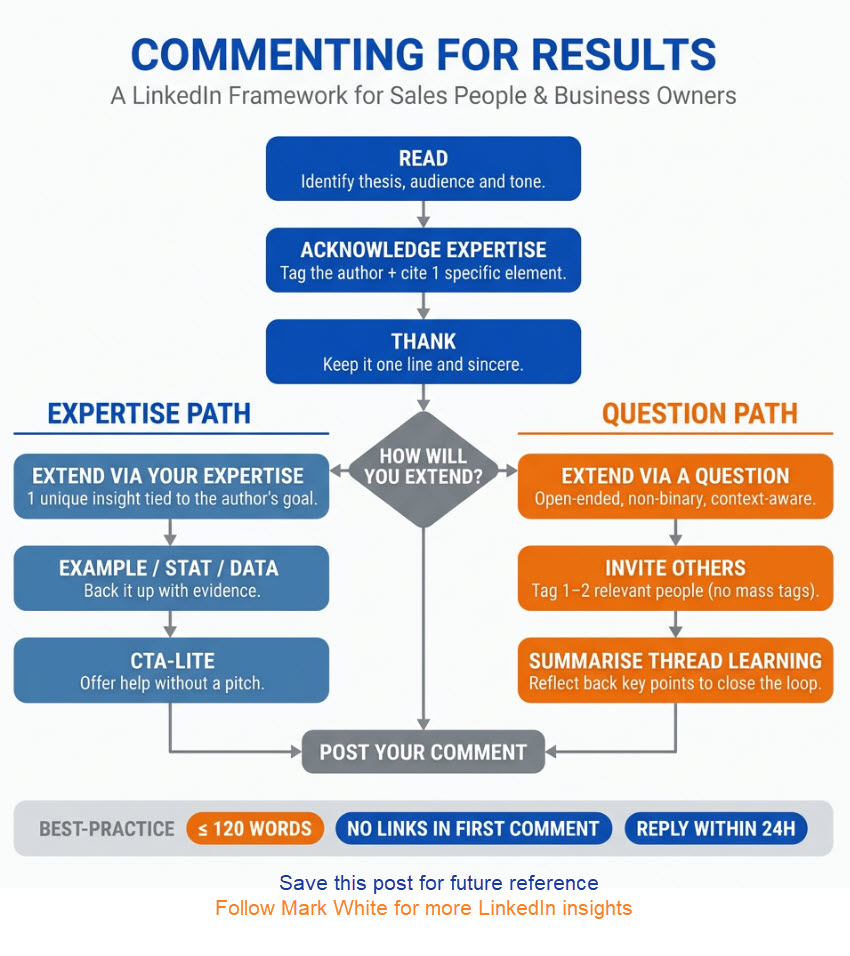
To make this effective, you don’t want to rely on your homepage feed which is LinkedIn driven and potentially random. Instead, identify the key people you want to be visible to – this could be prospects, industry influencers or perhaps people whose audiences overlap with yours – follow them (and ‘double ring’ the bell on their Profile) as a minimum, but ideally or use the “Posts search” technique to make sure you see their posts. Creating ‘Listening Groups’ is a brilliant way to get involved with and seen within a certain key area and build both visibility and reputation.
When they post, add something relevant – it’s best to add a perspective, share a relevant experience or maybe extend the conversation with a question. Use the RATE (Read – Acknowledge – Thanks – Extend) format if that helps – it certainly will allow you to open up the potential conversation.
To make this manageable, keep a short list of priority people whose posts you want to engage with regularly, rather than trying to comment broadly across the platform. If you have invested in Sales Navigator, then that gives you alternative methods to do this as part of the List building capabilities but the methods mentioned here work well on the free account of the site as well – in fact in some instances, they work better IMHO!
5. Account based selling on LinkedIn
For many of us, LinkedIn sales activity tends to focus on individuals, but for those selling into larger organisations, an account based approach can be really valuable or indeed essential. Rather than just putting all your eggs in one basket and targeting a single contact at a prospect company, you build visibility and relationships across multiple people within the organisation.
This means following and engaging with several people at your target company, understanding the organisation’s priorities through what its employees post and share (LinkedIn’s ‘Posts’ search with ‘Author Company’ activated is great for this), connecting with people across different functions who might influence a buying decision and then building familiarity at multiple levels before making any direct approach.
When you do then reach out formally, you are already a familiar name to several people within the business, and that can fundamentally change the dynamic of that conversation. In complex B2B sales especially, using a multi-threaded approach can significantly increase your chances of getting traction whereas a single point of contact strategy might struggle – it also increases your chances of keeping in with a company even if your main contact moves on!
6. Trigger based outreach
Finally, an underused yet really effective LinkedIn strategy so, rather than reaching out to prospects randomly or on a fixed schedule, you look for triggers. Effectively, trigger based outreach means monitoring for specific events that signal a prospect may be more open to a conversation than usual – and then reaching out at precisely that moment.
LinkedIn provides a surprisingly rich set of triggers if you know where to look. Someone changing job role is one of the strongest – new decision makers often review their suppliers and processes in the first few months. A company announcing growth, a new funding round, an office opening or a new product launch all signal an increase in activity and with it, a potential need.
A prospect posting about a challenge that you cover with your area of expertise is an invitation to engage. Even someone viewing your Profile or following your Company Page is a soft signal of interest worth acting on.
The power of this approach is timing – a message that gets ignored in February might get a warm response in March simply because something has changed in the prospect’s world. So, build a simple monitoring habit and check for these signals regularly across your priority prospect list – it gives you the chance to reach out in context, with relevance, rather than interrupting someone at a random moment with a generic pitch.
So, long post but one that I hope shows the different ways that we can leverage LinkedIn from a sales or business development perspective. There are such a lot of opportunities on LinkedIn if we take a step back and start with how we sell naturally in the real world and then use LinkedIn as a tool to help rather than get sucked into the LinkedIn hype.